Showing posts with label Religion. Show all posts

Monday, October 5, 2009

Thadingyut Fullmoon day in Chiang Mai, Thailand


Credit: zarny win, MoeMaKa News & Media.

Burmese migrant workers celebrated Thadingyut festival on October 04 at Wat Simon Burmese Monastery, Chiang Mai, Thailand.

According to Burmese calender, full-moon day for this year festival is on October 03, 2009. But it is on October 04 according to Thai calender. Most of the migrant people work at shops in Chiang Mai.

Many new migrants are arriving in Chiang Mai every day, searching for work. Burmese favourite food such as Samosa whichis seen in the photo is completely consumed before the dhamma-talk. Shops inside the monastery were seen very busy selling Shan noodle, fried Tofu and other Shan delicacies.

Saturday, September 26, 2009

Burma VJ Trailer

Burma VJ: Reporting from a Closed Country is a riveting documentary that follows a determined group of video journalists (VJs) who risk their lives to expose the repressive government ruling their country. Armed with pocket-sized video cameras, they go undercover to report on anti-government protests, smuggle material out of the country and broadcast back into Burma via satellite, or offer their stories for free usage to international media.

A winner at the 2009 Sundance Film Festival and the Amsterdam Documentary Festival, Burma VJ follows these local VJs as they record the massive anti-government protests led by thousands of Buddhist monks in Sept. 2007, and exposes the military junta's brutal crackdown which began on Sept. 26, 2007.

Friday, September 25, 2009

Remembering "Saffaron Solidarity"


Sept.24, 2007: Monks took to the streets in main cities in Burma, people joined forces and demonstrations grew to nearly 100,000 in Rangoon alone; the largest since 1988 nationwide protests.The junta imposes curfews and bans on gatherings. It later acknowledges arresting some 3,000 people.
Sept.26: The military's patience ran out. It launched a brutal crackdown, shooting and beating the protesters into submission.
Sept.27: At least 30 people were dead and thousands of monks were imprisoned or fled the country. But the Saffaron Revolution spirit never died.

Photos Credits: AltSean, Reuters, Getty Images, Flickr, Google

G-20 Summit: Burmese monks pray for human rights

Burmese monks pray for human rights
Friday, September 25, 2009
By Ann Rodgers, Pittsburgh Post-Gazette

Photo Credit: Darrell Sapp/Post-Gazette

Buddhist monks robed in hues of saffron, cinnamon and curry led 80 supporters across the Roberto Clemente Bridge toward the G-20 summit, chanting the same prayer for loving kindness with which they led an uprising for human rights in Myanmar two years ago.

A 25-year-old Burmese monk among them was an organizer of that "saffron revolution," in which hundreds of monks died. He fled Myanmar for his life.

Thursday, September 24, 2009

Saffaron Revolution Remembered Two Years Later


"Saffron Revolution, 2007"

August 15: Junta Removes fuel subsidies. Diesel doubles in price while gas jumps 500 percent.
August 27: Five hundred people protest in Pegu.
August 28: Three hundre monks from Sittwe began a protest calling for the release of detained student leaders.
Sept. 5: Burmese military regime broke up peaceful demonstrations by monks in Pakokku, injuring three.
Sept. 6: The monks in Pakokku took officials hostage and demanded an apology from the regime by Sep 17.
Sept. 17: Burmese military refused to apologize. All Burma Monks association called for a boycott on alms from officials.
Sept.24: monks took to the streets in main cities, people joined forces and demonstrations grew to nearly 100,000 in Rangoon alone; the largest since 1988 nationwide protests.The junta imposes curfews and bans on gatherings. It later acknowledges arresting some 3,000 people.
Sept.26: The military's patience ran out. It launched a brutal crackdown, shooting and beating the protesters into submission.
Sept.27: At least 30 people were dead and thousands of monks were imprisoned or fled the country. But the Saffaron Revolution spirit never died.

Photos Credits: AltSean, Reuters, Getty Images, Flickr, Google

Wednesday, September 23, 2009

Monks in Burma - Saffron Revolution Second Year Anniversary ( English Version)

Tuesday, September 22, 2009

Former Actor Kyaw Hein banned from delivering religious talks in Pegu

Credit: Irrawaddy News Magazine

Former Burmese Actor Kyaw Hein, now a Buddhist monk, was banned from making religious talk in Pegu.

Kyaw Hein, the most popular actor in the Burmese film industry, surprised fans with an announcement that he will retire in October, 2008, to become a Theravada Buddhist monk.

A vegetarian for the past several years, Kyaw Hein said he will enter the monkhood in November, and he plans to visit more than 100 townships to deliver religious talks, in a sort of farewell tour which will extend into 2009.

The 61-year-old actor disclosed his decision at a press conference on September 2, in which he thanked journalists for writing about him during his 40-year career. The entertainment press gave the superstar’s announcement respectful attention, although some questioned if he was right for the role of an ascetic monk.

Thursday, September 17, 2009

Burma’s second Saffron Revolution?

Exiled Burmese monk King Zero, one of the instigators of the 2007 Saffron Revolution, forewarns further democracy rallies in Burma.

Unless the ruling military junta apologises for killing and imprisoning monks by October 2, King Zero says monks will launch a boycott and again lead demonstrations against the government.

Watch Video at Sydney Morning Herald

Credit: Burma Digest

Saturday, September 5, 2009

History of Revolutions: In Memory of Saffaron Revolution in Burma

Historic Parallels To Today's Protests
By Stuart Whatley, Huffington Post (06-16-2009)

The massive socio-political movement in Iran, following the highly controversial announcement Saturday declaring Mahmoud Ahmadinejad the victor of that state's presidential election, is reminiscent of a number of other such uprisings during the past few decades -- with some being notably more violent than others. However, it should be noted, the situation in Iran is by no means a "revolution" at this junction, and experts and pundits aplenty agree that such an appellation would be both premature and inappropriate. Nevertheless, a look back is merited, given the situational picture painted by images, video and reports that have made their way out of Iran thus far.

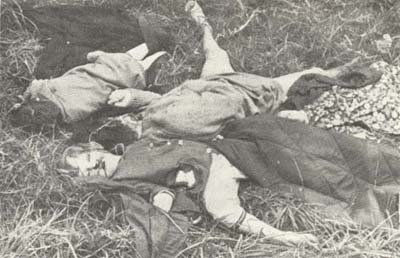
An especially violent historical parallel is Rhodesia's (now Zimbabwe) Second Chimurenga, that began in 1964 and lasted until 1979, which began as a civil disobedience movement, but escalated into civil war against the minority white colonial ruling faction. The eventual result was Zimbabwean independence, with Robert Mugabe taking power over the new Republic of Zimbabwe in 1980. Read more here.

Second Chimurenga
2009-06-16-Attrocity1.jpg


A more peaceful example is Portugal's 1974 Carnation Revolution, which saw thousands of civilian dissidents take to the streets to side with military insurgents in the country's two-year-long civil war. The eventual result was an almost bloodless coup whereby an authoritarian regime was supplanted by democracy. Read more here.

Carnation Revolution

2009-06-16-25abril.jpg


A very obvious parallel to Iran today is of course the Iranian Islamic Revolution of 1979, when demonstrators brought the country to a standstill and forced the US-backed Shah to flee. The result was that the monarchy was replaced with the current Islamic Republican system. Read more here.

Islamic Revolution

2009-06-16-Mass_demonstration.jpg


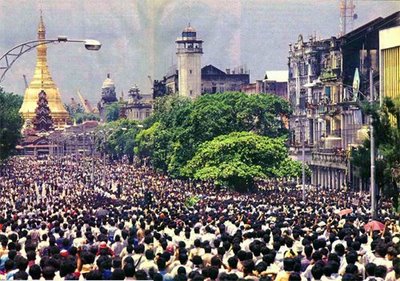
A popular uprising that saw far more bloodshed, however, is the 8888 Uprising in Burma (also known as Myanmar), when on August 8, 1988 student protesters joined with monks, doctors, housewives and even children in a call for democracy. The movement ended with the slaughter of thousands of protesters by the Tatmadaw (Burmese Armed Forces). This is also when opposition leader Aung San Suu Kyi, now on trial, entered politics. Read more here.

8888 Uprising
2009-06-16-8888_Uprising.jpg

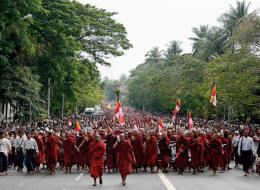
Another uprising in Burma came in September 2007, when tens of thousands of monks marched through the streets of all major cities to demand political change and better living conditions. The movement, called the Saffron Revolution because of the monks' red robes, grew to include Burma's former student leaders called the '88 generation as well as a new generation of dissidents. The protesters used new media tools like cell phones and Google Chat to send information on their uprising to the international community. However, like in 1988, the army quickly sent in troops, killing dozens if not hundreds of protesters and arresting thousands.

Saffron Revolution

Perhaps the most well-known (despite government efforts) similar example, however, is China's Tiananmen Square protests of 1989. The protests saw upward of one million people -- many of whom were students and intellectuals -- gather in and around Tiananmen square following the death of pro-democracy, pro-capitalism opposition leader Hu Yaobang. The protests grew into a larger outcry against government corruption and ended in a massacre. Read more here.

Tiananmen Square Massacre

2009-06-16-tiananmen2.jpg


Less violent and also in 1989 was Czechoslovakia's Velvet Revolution against the ruling Communist party. Thousands of students took to the streets, only to be suppressed by armed police. Their suppression, consequently, led to even larger demonstrations and nationwide strikes, eventually forcing the Communist government to step down. Read more here.

Velvet Revolution

2009-06-16-_32620_praguedemo1.jpg


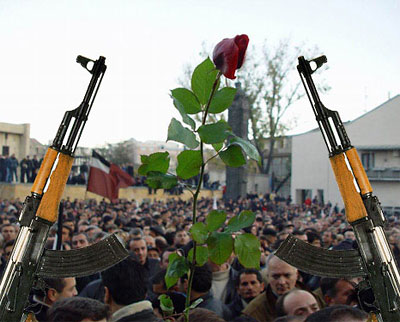
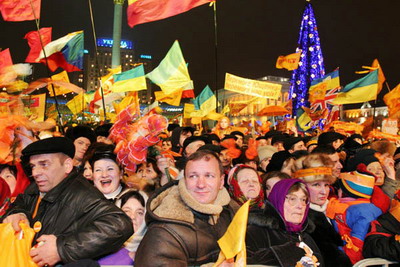
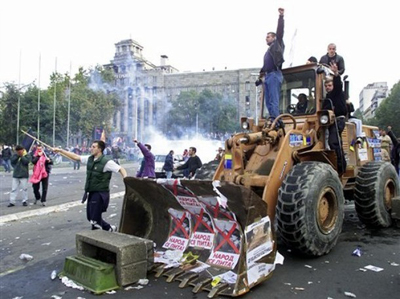
Similarly, what has become known by many as the Colour Revolutions took place in four countries and were characterized by mostly non-violent demonstrations in post-Communist Eurasia. They are: the Bulldozer Revolution in Serbia in 2000; the Rose Revolution in Georgia in 2003; the Orange Revolution in Ukraine in 2004; and the Tulip Revolution (also known as the Pink Revolution) in Kyrgyzstan in 2005.

Bulldozer Revolution
2009-06-16-610x.jpg

Rose Revolution

2009-06-16-roserevolution.jpg

Orange Revolution

2009-06-16-revolution.jpg

Tulip Revolution

2009-06-16-revolution.jpg


It should be stressed that no two "revolutions"/uprisings/mass demonstrations can ever be the same. However, reflecting Mark Twain's insight -- that, though history never repeats itself, it can sometimes rhyme -- there are often notable parallels. The Colour Revolutions shared a mostly nonviolent approach centered around a symbolic color (much as we are seeing now in Iran with Mousavi's "Green Wave"). And Tiananmen and Burma were begun by students and young intellectuals from the universities (also similar to the current Iranian demonstrations, though Iran expert Trita Parsi points out that it is far more heterogeneous than that which is assumed).

Sunday, May 3, 2009

In memory of people who died in Burma Cyclone Nargis in May 2008.

Friday, September 26, 2008

Video: MaSoeRein Sa Ya Daw Gyi's Speech & Student Leader Moe Thee Zun

In memory of "Saffaron Revolution" in September 2007 when Burmese military regime launched a brutal crackdown on innoncent monks and protestors.